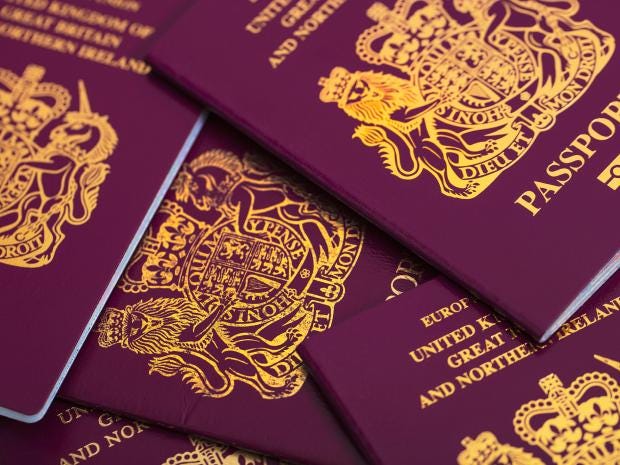
People born in Northern Ireland will be able to retain their EU citizenship under the deal struck by Theresa May early this morning.
Under an existing agreement between the UK and EU, anyone born in Northern Ireland is entitled to an Irish passport, which confers EU citizenship because of the Republic’s membership of the EU.
The deal published on Friday says this arrangement, which is part of the Good Friday agreement, will continue, effectively allowing the province’s population to opt in to be EU citizens.
“Both Parties acknowledge that the 1998 Agreement recognises the birth right of all the people of Northern Ireland to choose to be Irish or British or both and be accepted as such,” the joint text agreed by the two sides states.
“The people of Northern Ireland who are Irish citizens will continue to enjoy rights as EU citizens, including where they reside in Northern Ireland.”
The agreement is in line with a demand in a British position paper released in August, that “the people of Northern Ireland who are Irish citizens – or who hold both British and Irish citizenship” will enjoy the rights of EU citizenship.
The European Commission had also suggested in a position paper that “full account should be taken of the fact that Irish citizens residing in Northern Ireland will continue to enjoy rights as EU citizens”.
It comes amid a breakthrough on the Irish border issue, allowing the UK to move to trade and transition talks with the EU after a summit next week.
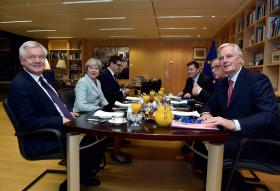
The smiles belie the long road ahead. Source: Bloomberg
Leading German business organizations expressed relief that Britain and the European Union had struck a last-minute deal over the terms of Britain’s departure from the 28-nation trading bloc, and urged both sides to pursue the more important question of how trade will work once the terms of Brexit are sealed.
Earlier on Friday, the European Commission said enough progress had been made after the two sides worked through the night to end an impasse over the status of the Irish border, easing the pressure on UK Prime Minister Theresa May. The Irish issue was the last major obstacle to opening trade talks with the EU, a step leaders are widely expected to approve at a Brussels summit on December 14-15.
“I assume that we have reached the breakthrough we needed,” said Commission President Jean-Claude Juncker in Brussels, who added that much remained to be done. Comments from Berlin echoed that sentiment. “I think everyone understands that there is still much work for negotiators to do even if the European Council decides to move into phase two of Brexit negotiations,” German government spokesman Steffen Seibert said.
According to the EU’s chief Brexit negotiator, Michel Barnier, the terms of Brexit must be agreed by October 2018 to be binding. Britain is currently set to relinquish its EU membership on March 29, 2019 and enter a two-year Brexit transition phase.
“The most difficult part of the negotiations still lies ahead. London shouldn't delude itself.”
“Consensus over the exit terms clears the way for the issues that companies are dying to discuss,” said Eric Schweitzer, head of the German chambers of commerce, known here by the acronym DIHK. Next on the agenda are key matters of how to deal with border customs, the movement of skilled personnel, and safeguards for existing contracts for loans and insurance, he said. “A lot is at stake for German business,” Mr. Schweitzer added. “The UK is Germany’s fifth-biggest trading partner with goods turnover of more than €120 billion last year.”
Today’s news assuaged fears that companies on both sides of the English Channel might face a so-called “hard Brexit,” the departure of the UK with virtually no trade deals in place to replace the advantages of EU membership. In recent months, German business associations voiced increasing alarm at the lack of progress, and they weren’t alone. On the eve of Ms. May’s meeting in Brussels, Paul Drechsler, head of the British business lobby CBI, warned that 60 percent of firms with Brexit contingency plans would activate them by Easter 2018 unless the UK got the green light for trade talks with the EU.
Joachim Lang, director of the German industry federation BDI, said he was relieved but that the next round of talks should be pursued with renewed verve. “The most difficult part of the negotiations still lies ahead,” he said. “London shouldn’t delude itself. Our companies need to know quickly which model Downing Street sees for a future treaty and what the transition phase will look like.”
“It was to be expected that the Brits would have to move. But we’re not even half-way there.”
The second round of Brexit negotiations will deal mainly with molding trade relations between the EU and UK. The first round was concluded with a 15-page document that tackled 95 issues, many of which remain open. As far as finances are concerned, it is now clear that the UK will make a regular contribution to the EU’s budget in 2019 and 2020, as if it were still a full EU member.
Clemens Fuest, head of Germany’s Ifo research institute, urged the EU to strike a comprehensive free-trade deal with Britain in order to limit the costs of Brexit for all parties. In the absence of a free-trade deal, the UK would revert to trade rules of the World Trade Organization. “The rising cost of doing trade after Brexit will wreak substantial damage,” the economist said, pegging the total price tag for the EU at €27 billion, or $31.7 billion. “A free-trade agreement could more than halve the additional costs.”
Britain has a similar interest in getting a deal done. Without a free-trade deal, the UK’s financial costs from Brexit would outweigh its annual EU budget payment by €16 billion per year, estimated Mr. Fuest. With a deal, the EU budget costs would be roughly canceled out. “Everyone loses from Brexit,” the economist added.
A recent European Parliament study found that Germany alone would have to pay about €3.8 billion more each year into the EU budget after the UK’s departure.
Analysts responded with muted enthusiasm to the agreement. “A hard Brexit is obviously no longer an issue,” said Thomas Altmann, portfolio manager at investment firm QC Partners. While negotiations on future economic relations won’t be easy, at least they are starting, he added.
Carsten Brzeski, chief economist of ING-Diba in Frankfurt, was less optimistic. “It was to be expected that the Brits would have to move. But we’re not even half-way there,” he said. “A lot has been said about the past, but little about the future. How will future relations be, from trade to politics? A lot of questions are still unanswered.”
Both the euro and British pound strengthened against a basket of currencies, while financial markets across Europe rallied on the Brexit news. By mid-afternoon on Friday, the DAX index of 30 German blue chips gained 1.1%, while the UK’s FTSE 100 index rose 0.9% and France’s CAC 40 index was up 0.4%.
Even for a politician with a penchant for bare faced hypocrisy, yesterday’s effort from Nicola Sturgeon took the biscuit. Her demand for a cross-party effort to thwart a “reckless UK Government from driving the whole country over a cliff edge” was literally breathtaking.
Here was a politician, who only 18 months ago had charged her civil servants to draw up plans to break up Britain after the EU referendum result. Yet here she was calling for Unionists to join her to stop a hard Brexit.
The First Minister could have launched such a movement at any time during the last year-and-a-half if she’d been prepared to do one thing: put the interests of her constituents before that of her party.
She would have had to abandon her pursuit of Scottish independence, something that was decisively rejected in a referendum three years ago. But that was the last thing she was prepared to do, because she knows...
A seven-year-old U.S. startup is set to become the biggest private tenant in London just as the U.K.’s economic outlook worsens. By
Jack Sidders
and
Giles Turner
Updated on
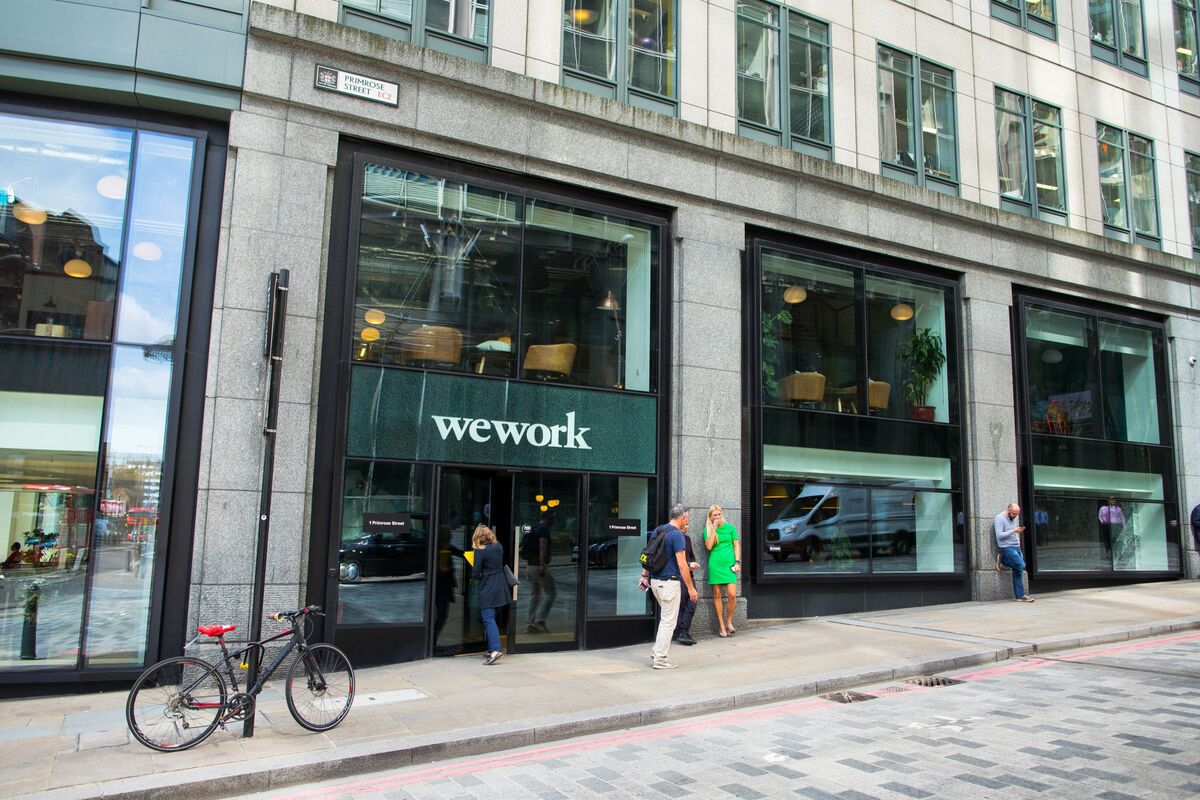
WeWork’s shared office space in London.Photographer: Jason Alden/Bloomberg
Company will become London’s largest private renter of offices
Softbank met competitor IWG ahead of investment in WeWork
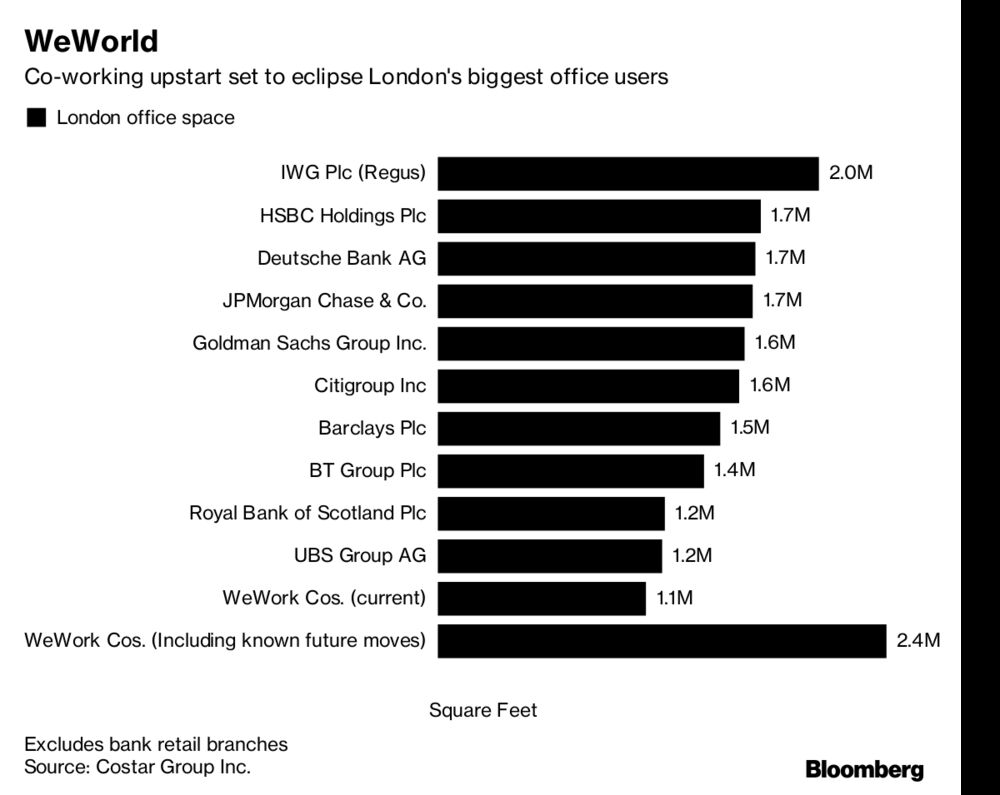
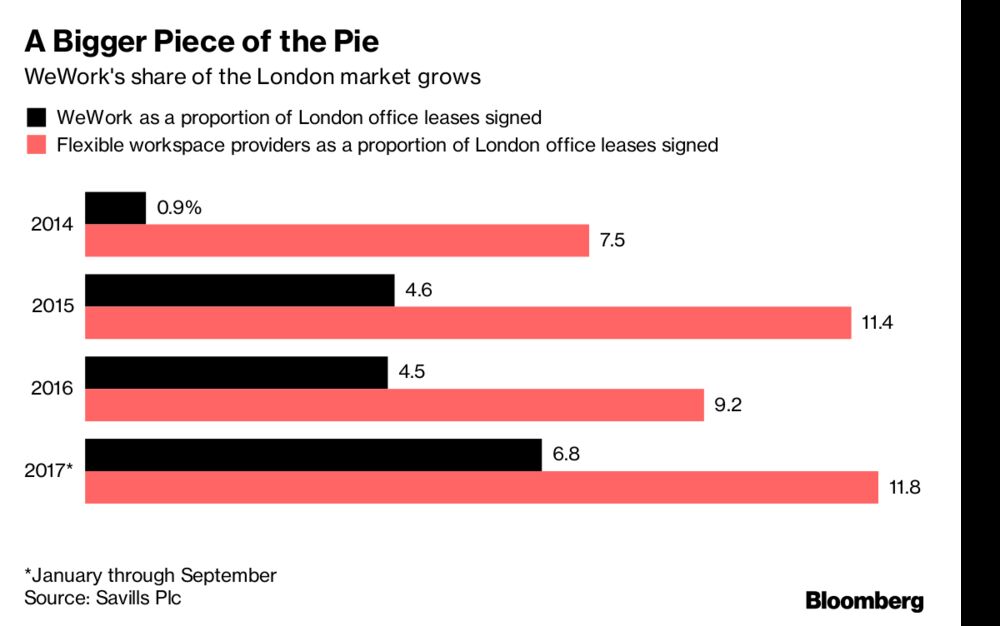
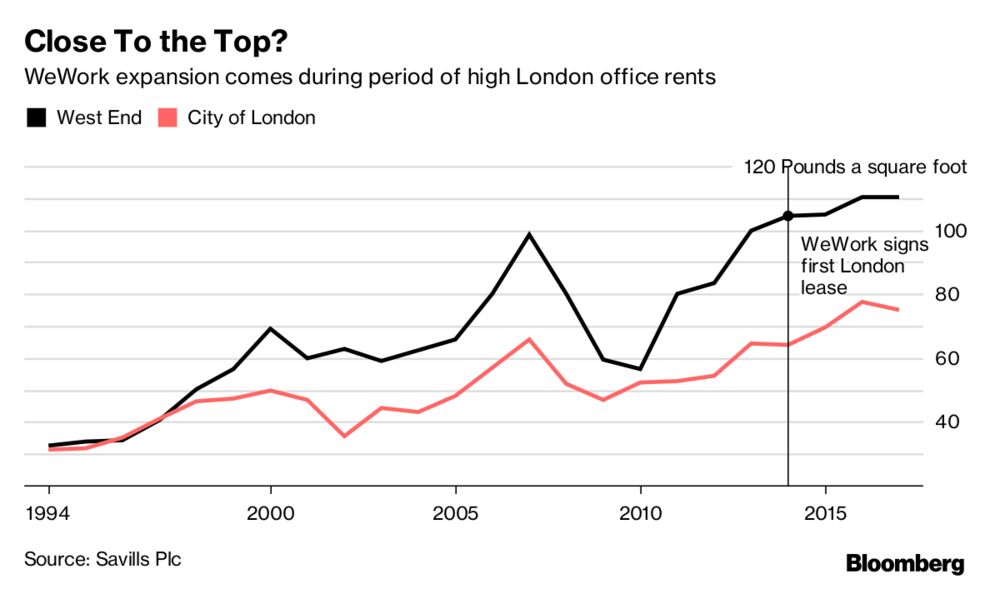
Three years after entering the British capital, WeWork Cos. has signed leases that will make it the city’s No. 1 private-sector user of office space, according to data compiled by CoStar Group Inc. for Bloomberg. The rapid growth makes WeWork, valued at $20 billion, increasingly important to the health of the city’s property market as well as more vulnerable to any future decline in rents. “A downturn of some description has to happen at some point, and when it does the serviced office business will suffer very quickly,” said Michael Marx, the veteran developer who ran Development Securities Plc for 21 years through 2015. “In the present uncertain market many people are hoping that the WeWork model works -- but we have no idea whether it does on a sustainable basis or for how long. It appears to be a well-capitalized business, but if the cycle turns down, then the model looks vulnerable.” WeWork’s success in London depends on demand for flexible office space growing fast enough to keep rental income above the historically high rates the company pays to lease its properties. While the company has acknowledged that Brexit poses economic risks, it also said that uncertainty surrounding the move will support its business as companies remain wary of long-term commitments. WeWork, through a spokeswoman, declined to be interviewed for this story. The firm currently operates 17 London locations, with two more opening soon and a further 10 announced. It has also begun buying some buildings and is in talks to purchase a 12-building campus close to Liverpool Street station from Blackstone Group LP for about 600 million pounds ($807 million). Peter Grauer, chairman of Bloomberg LP, is a non-executive
director at Blackstone.
WeWork’s most basic membership plan, which allows access to the company’s offices two days a month and use of the firm’s app, starts at $45 a month, according to its website. The company ran a promotion this summer offering tenants half of their lease for free in an attempt to fill that space. In some cases, it has also paid brokers fees of as much as 20 percent for bringing in tenants, double the industry norm, people with knowledge of the matter said. WeWork’s standard broker payment is 10 percent, another person said.
“In typical English fashion, we frown on the new boys,” said Jonathan Goldstein, chief executive officer of Cain International, a developer and lender that is involved with two large London projects leased to WeWork. A multi-billion dollar injection by SoftBank Group Co., which he called a sophisticated investor, “is going to change the dynamic in the market.” Goldstein was speaking at an event organized by Bisnow on Business Inc.
Future Payments
WeWork’s rapid growth in London means that at a minimum it has committed to paying about 815 million pounds of rent in the future. Of that, 231 million pounds must be paid over the next five years, according to its British unit’s accounts filed in late October. Membership income for WeWork UK Ltd. was 61 million pounds in 2016 and the division posted a loss of 11.1 million pounds.
Jamie Hopkins, CEO of WeWork competitor Workspace Group Plc, said he prefers a business based on purchasing the properties the company rents out as short-term offices.
“Buying long-term leases and selling short ones at a profit is not a model we are comfortable with at all,” Hopkins said in an interview. Owning its buildings gives Workspace “much more flexibility in terms of pricing if we need it,” he said.
Growing demand for flexible leases has drawn increasing competition. Blackstone bought The Office Group for about 500 million pounds earlier this year and plans to expand the business while British Land Co., the U.K.’s second-largest real estate investment trust, has started Storey, a new flexible workspace brand. There were almost 1,140 serviced office and co-working facilities in London in April 2017, up from around 490 in 2012, according to data collated by broker Instant Offices.
Founded in 2010 in New York, WeWork started life offering short-term offices and has expanded into a diverse range of areas, from co-living to kindergartens, all of which center on the idea of creating a community. Created by Israeli Adam Neumann and American Michael McKelvey, the company has also begun branching out from purely leasing office space and has now begun purchasing properties in London and New York.
Free Beer
WeWork has average occupancy of 90 percent across its London portfolio, according to a spokeswoman. Part of WeWork’s appeal is that tenants are sold memberships, rather than leases, which offer access to an app designed to facilitate collaboration with other occupants, together with regular events, discounts on a range of services from gym membership to health insurance, as well as free beer and prosecco, all designed to foster a sense of belonging.
In recent years, big companies as well as startups have chosen to use co-working spaces for some employees. WeWork has secured deals with firms including International Business Machines Corp. and Amazon.com Inc. in its U.S. business and is seeking similar deals with blue-chip tenants in London.
All Sizes
Some companies have as many as 600 people in WeWork sites, McKelvey, the chief creative officer, told Bloomberg in an interview in July.
“Our approach appeals to companies of all shapes and sizes,” he said, discussing a plan to expand rapidly in Latin America. The chief creative officer also described WeWork’s approach to growing quickly.
“To build out locations is a challenge,” he said. “But we came out with a very sophisticated platform of how we manage that whole process and it allows us to run it like a software development process, and it gives us a lot of confidence in our ability to execute.”
London remains one of the world’s most expensive office markets even after the Brexit vote. The U.K. capital’s West End district ranks as the second most expensive globally with an occupancy cost of $213.80 a square foot a year while the City of London borough, where WeWork’s largest building is located, ranked 11th, according to a June report published by broker CBRE Group Inc.
Brexit could cause as many as 75,000 job losses in banking and insurance, largely based in the City, if the U.K. leaves the European Union without a trade deal, according to Sam Woods, chief executive officer of the Bank of England’s Prudential Regulation Authority. Prime Minister Theresa May’s chances of getting breakthrough that would allow the U.K. to begin trade talks with the EU receded this week as the Northern Irish party that backs her government continued to resist a deal and she faced a cabinet rebellion over her strategy for quitting the bloc.
Companies are at risk of losing so-called passporting rights, which allow them to trade goods and services freely throughout the bloc.
The risk involving future lease payments is partly offset by the arrival of WeWork’s latest investor. In August, SoftBank Group Co. and its $97 billion Vision Fund agreed to invest $4.4 billion, which is helping finance its global expansion plan. The deal valued WeWork at $20 billion.
Before the deal was announced SoftBank Vice Chairman Ron Fisher -- who led the investment -- met with executives at IWG Plc, a competitor with a much lower valuation and more than 10 times as many sites, people with direct knowledge of the matter said. The meeting was held to better understand the temporary office business model and address the investor’s concerns over WeWork’s valuation, they said.
A month later, SoftBank revealed its investment and Fisher, a long-time lieutenant of SoftBank Chief Executive Officer Masayoshi Son, joined WeWork’s board alongside Mark Schwartz, SoftBank’s external director and the former Asia Pacific chairman at Goldman Sachs Group Inc.
Competitor’s Struggles
IWG, in its former incarnation as Regus, filed for bankruptcy protection for its U.S. business in 2003 after it expanded too rapidly in the dot-com boom. IWG has a market value of just 1.8 billion pounds despite having nearly 3,000 locations worldwide compared to WeWork’s 235. More recently, the Swiss company has seen the value of its shares drop almost 40 percent since Oct. 19 when it issued a profit warning, citing in part weakness in the London market.
IWG is “the same business, the returns are the same and there is no difference -- there’s no alchemy in it,” CEO Mark Dixon said in an interview about half-year earnings, comparing his company to WeWork.
A spokesman for IWG declined to comment on the SoftBank meeting. A representative of Tokyo-based SoftBank declined to comment.
While WeWork has helped stoke demand for London’s office space, some say the risk is simply being passed down the chain. Rather than a landlord needing to rent out its offices, it’s now WeWork, the renter, that needs to find a steady supply of businesses to fill its spaces.
“When serviced office occupiers take space, that isn’t actually affecting the vacancy rate, yet people think it does,” Rob Noel, CEO of Land Securities Group Plc, the U.K.’s largest real estate investment trust, said in an interview. “You are effectively transferring risk from a landlord to an intermediary, that space still needs to be let out.”
Major Backer
Despite the risks, WeWork has its backers in the London property market. “I hear people say it is going to blow up any minute now, but they have got major investors,” Tony Gibbon, founder of broker GM Real Estate said at the Bisnow event. “People question the valuation but so what, it is a considerable scale and it is a trend that isn’t going to disappear.”
While Brexit and political discord in the U.K. may play into the hands of companies providing flexible leases, WeWork’s scale could give it an advantage over competitors, enabling it to offer customers access to buildings around the world as well as a range of additional services.
“There are clearly risks associated with the speed of expansion of WeWork,” Toby Courtauld, CEO of London office landlord Great Portland Estates Plc, said in an interview. “It is probably too early to call whether that’s a systemic problem or in fact is a fantastic call by them.”
Even as Brexit talks lurch from one hurdle to another, the pound is enjoying a rising wave of confidence among investors and analysts.Aberdeen Standard Investments recently added to sterling long...
By
Anooja Debnath
Updated on
Aberdeen, SEB see sterling at 80 pence to the euro in 2018
Pound risk reversals reach most bullish level in two months
Viraj Patel, FX strategist at ING, discusses the impact of Brexit negotiations on the pound.
Even as Brexit talks lurch from one hurdle to another, the pound is enjoying a rising wave of confidence among investors and analysts.
Aberdeen Standard Investments recently added to sterling long positions, betting it will rally in 2018 as Britain and the European Union make better progress in their negotiations than the market expects. The currency will also benefit from the prospect of interest-rate increases by the Bank of England, according to the U.K. firm and JPMorgan Asset Management. Strategists at SEB AB recommend buying the pound while those at Nomura International Plc see room for gains next year.
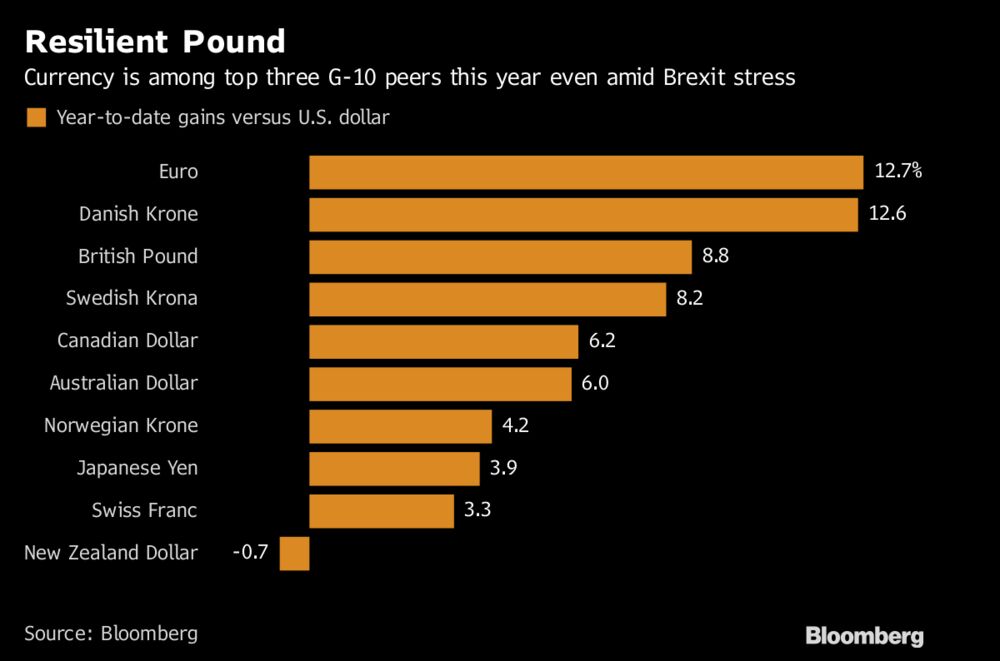
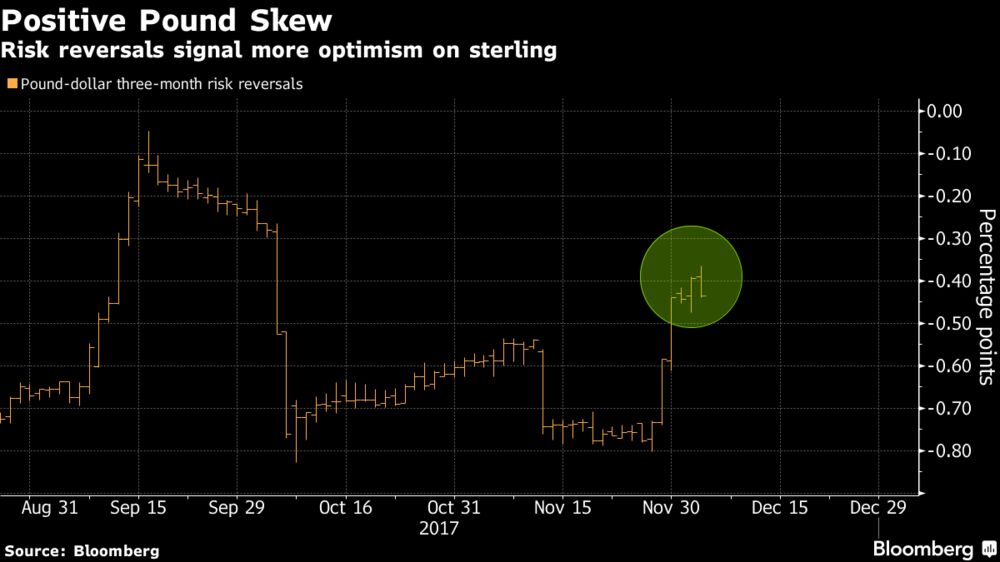
Option-market sentiment on sterling is now the most bullish in two months and it is one of this quarter’s top performers among major currencies against both the dollar and euro. Concessions made by Britain last week on the contentious Brexit bill suggests the likelihood of further “U.K. capitulation” on other topics, allowing a transitional deal and giving the BOE a green light to raise rates, according to Nomura strategists including Jordan Rochester.
“There is too much pessimism about the path of the U.K. economy,” said James Athey, a senior investment manager at Aberdeen Standard, which oversees a total of 670 billion pounds ($899 billion) in assets worldwide. “There’s too much pessimism on the negotiations and the future relations with the EU and I think BOE interest rates will be higher by the end of 2018. I am still long sterling and I’ve added to that position recently.”
Option Optimism
The pound slipped 0.4 percent to $1.3425 as of 10:10 a.m. in London on Tuesday, after the U.K. and the EU failed to get a much-hoped breakthrough on Brexit with the issue of an Irish border derailing a tentative deal. Against the euro, sterling was 0.4 percent weaker at 88.33 pence. Still, three-month risk reversals in the British currency against the dollar, a measure of the appetite for bullish options relative to bearish ones, traded near the highest since Oct. 5 reached on Tuesday.
The increased sterling optimism is also evident from Bloomberg currency surveys. About a fourth of the predictions see the pound rising to $1.40, a level not since the Brexit referendum, in the coming year. A year ago, there were no forecasts for that level to be met any time in 2017.
Aberdeen Standard’s Athey prefers to express pound optimism against the euro rather than the dollar, saying that there has been “far too much exuberance” in Europe’s shared currency. He sees sterling strengthening almost 10 percent to 80 pence per euro “over the medium term.”
Selling the euro against the pound with a target of 80 pence is among the top 2018 trade recommendations from SEB strategists including Richard Falkenhall. Nomura is “still short euro-sterling, looking for 0.87 and pound-dollar to break its September highs and approach $1.40 in the new year,” strategists at the bank wrote in a client note dated Nov. 28.
Rate Outlook
Aberdeen Standard’s Athey and Nicholas Gartside, chief investment officer for fixed income at JPMorgan Asset, see room for the BOE to raise its benchmark rate twice next year, compared with current money-market pricing for a single 25-basis-point increase by November 2018.
While uncertainties around the U.K.’s exit from the EU still linger, the fact that the pound is set to end the year stronger shows markets are becoming less sensitive to the ups and downs of the protracted Brexit process, according to Gartside. With a little more clarity on Brexit and a likely transition deal there was “no reason” for the pound not to climb toward $1.40 next year, he said in an interview.
“A no deal exit” would be “accompanied by substantial wealth losses in both the U.K. and EU,” SEB analysts wrote in a client note last week. “Given the size of the risk premium, a breakthrough in negotiations would most likely trigger a substantial sterling recovery in 2018. Partly, this may even happen in December if exit talks progress sufficiently to open up negotiations on the future relationship between the EU and U.K.”