Sunday, 22 May 2016

EU referendum: Daily Mail breaks with Mail on Sunday to back Brexit

Newspaper's official support for Leave comes two days after sister publication urged its readers to vote Remain


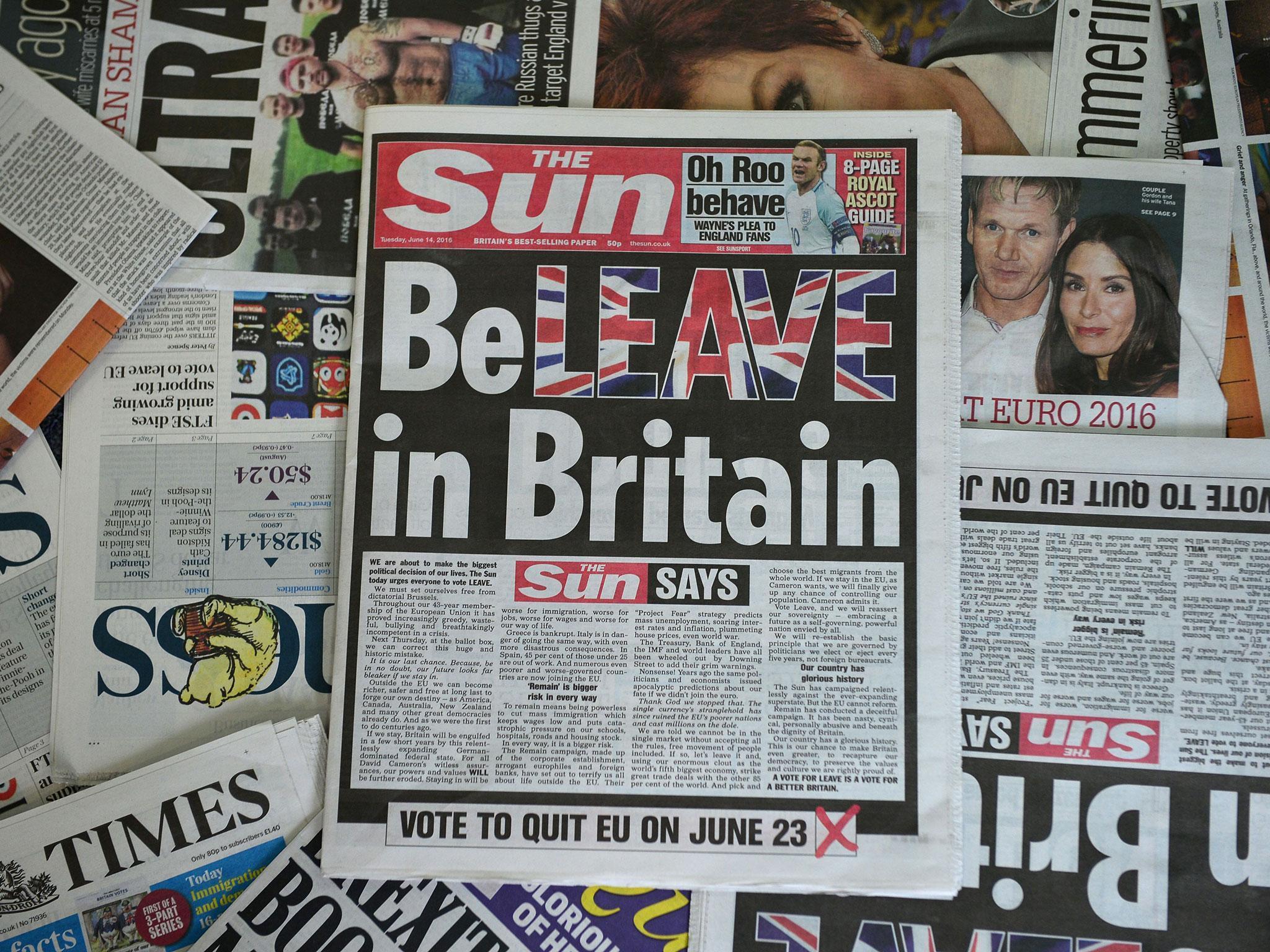
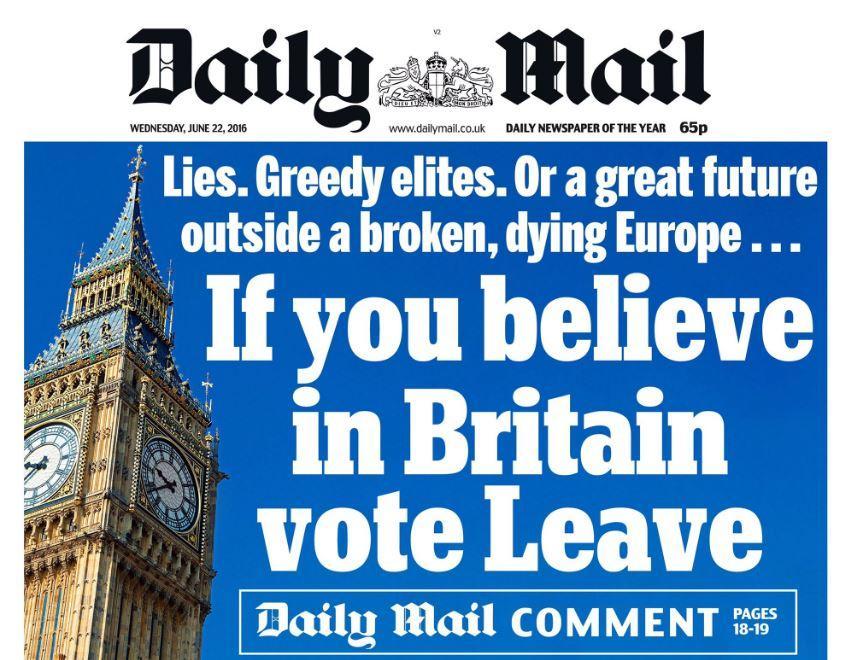
The Daily Mail has broke with its sister paper The Mail on Sundayto formally back the campaign for Britain to leave the EU. 
In a two-page editorial, the newspaper argued it was best for the country to vote to leave the union in Thursday's referendum.
The declaration came two days after its sister publication The Mail on Sunday - which is a separate publication with a different editorial team - urged its readers to vote Remain.
It warned that "by any calculation" Britain would face higher tariff and economic uncertainty, saying it was "not the time to risk the peace and prosperity" of the UK.


The split has been interpreted by some media watchers as indicative of a split within both papers' parent company, Associated Newspapers, over the issue.
Journalists said it was an example of the editors choosing the stance of their own papers without the influence of their proprietor, Lord Northcliffe. 
The Mail on Sunday has been edited by Geordie Gregg since 2012 and Paul Dacre has edited The Daily Mail for more than 20 years. 
Despite this, the national paper's declaration has not been included on the front page of its Scottish edition. 
The Scottish Daily Mail has run on a different front page story about David Cameron's plea for voters not to "let Brexit destroy the union". 
Scottish voters are widely regarded as fair more pro-EU than their English neighbours and there have been warnings that the country will face calls for a second independence referendum if Britain as a whole votes to quit. 
The papers are not the first to come to different conclusions about their stance. 
Last week The Times declared for Remain whereas its sister title, The Sunday Times, opted for Leave. 
Its stablemate, The Sun, also choose Leave which some on Twitter have said was due to the influence of its proprietor, Rupert Murdoch, - a charge denied by its associate editor Trevor Kavanagh
The Daily Mail's decision will come as no surprise to some as many commentators noted the paper's largely anti-immigration stance over the past few years. 
A study by Loughborough University analysing media coverage of the referendum found that The Daily Mail was the second most pro-Brexit daily newspapers after The Daily Express - which has campaigned for the country to leave the EU for several years. 

https://www.independent.co.uk/news/uk/politics/eu-referendum-daily-mail-breaks-with-mail-on-sunday-backs-brexit-a7094606.html

Wednesday, 11 May 2016

How the Treasury cooked the books in calculating the impact of Brexit

Three weeks ago, the Treasury released its report into the long-term implications of Brexit, predicting widespread economic destruction.

Wednesday 11 May 2016

Ryan Bourne
Ryan Bourne is head of public policy at the Institute of Economic Affairs.
Coast Guard Boards Foreign Ships To Check Security
If Britain were to adopt unilateral free trade, exiting the EU’s protected customs union
would lead to UK consumers enjoying lower prices (Source: Getty)

There will soon be a sequel, analysing what the short-term impacts of leaving the EU might be. One doubts you’ll need the foresight of those who successfully predicted a Leicester City Premier League victory to guess what this will conclude.
Yet the economic methodology of the Treasury’s work really does need to be questioned. Due to the rapid response nature of modern media, it was impossible for those favouring Brexit to offer up a thorough critique of the first report quickly. One could only show it was riddled with bizarre assumptions. Not least, it assumed away by construction any benefit of Brexit in terms of signing third-party trade deals or deregulating the economy.
For those on the Remain side, of course, it sufficed to merely herald the Treasury’s results as reflecting the “economic consensus”. Surely if anything has been proven in the economic history of post-war Britain, it is that economic consensuses are a weak appeal to authority.
To fill the void of analysis on the Treasury study comes the second publication by the new group Economists for Brexit. In this report, professor Patrick Minford provides an accessible history of trade theory before critically evaluating the Treasury’s work.
Minford explains that the way the Treasury models Brexit is to focus on “openness”, the sum of imports and exports relative to GDP, and foreign direct investment (FDI). These two factors are each assumed to follow a so-called gravity model – where openness is related to things such as distance – estimated from multi-country data. The degree of openness and FDI are then assumed to determine productivity – the ultimate driver of living standards, estimated from industrial data. Finally, this productivity effect is added into a macro model to find the general effects on investment, GDP etc.
The broad story the Treasury tells is thus this: Brexit will make the UK less open and less attractive for FDI. This will lead to lower productivity and therefore less investment and lower living standards.
There are several major problems with this method. The first relates to identifying the effect of EU membership per se. In order to find this, large regressions over time and across countries are run to isolate the “EU effect”. But this is estimated using a binary assessment of whether a country is in or out. This throws up all sorts of potential biases because it calculates the EU effect across periods with many other different policies. Many of these factors may be related simultaneously to a country’s openness or FDI and its decision to be an EU member.
The second problem is that the Treasury modelling assumes that openness and trade drive improved productivity. While intuitive and in many cases true, this need not be the direction of causation. In fact, it might be that an industrial shock can cause increased trade, FDI and productivity simultaneously. In other words, the UK may receive FDI precisely because an industry becomes more productive. To assess how Brexit would affect this, you’d need to do far more extensive work on industries and causal testing than the Treasury attempts.
Finally, the Treasury comes to vastly different conclusions to Minford’s previous Economists for Brexit modelling (which suggests that we would be better off out of the EU) primarily because it assumes that, if we leave and do not sign a trade deal or remain in the Single Market, Britain will maintain EU-style tariffs on EU partners and non-EU trading partners who have EU trade agreements. These assumptions therefore generate large effects on openness and on FDI – and hence living standards.
In fact, if instead Britain were to adopt unilateral free trade (abolishing all tariffs), exiting the EU’s protected customs union would lead to UK consumers enjoying lower prices and would shift the structure of production towards non-protected sectors, enabling us to focus on real areas of comparative advantage and raising productivity. We would, of course, have full control over regulation too.
The need for a smoothed transition may prevent this “big bang” disruptive approach. As Roland Smith of the Adam Smith Institute pointed out this week, the government and Parliament that will negotiate our exit settlement will be overwhelmingly pro-Remain and may well choose the least disruptive short-term path: remaining in the Single Market in the European Economic Area. But the largest long-term gains from Brexit require an independent, free-trading Britain.
City A.M.'s opinion pages are a place for thought-provoking views and debate. These views are not necessarily shared by City A.M.
http://www.cityam.com/240777/how-the-treasury-cooked-the-books-in-calculating-the-impact-of-brexit

Saturday, 30 April 2016

JAPAN TIMES Brexit Headlines: Apr 2015 - Apr 2016

The Japan Times
Brexit Headlines

Obama meets British royals, backs Cameron against BrexitWORLD / POLITICSAPR 23, 2016

President Barack Obama plunged into a whirlwind of royal socializing Friday that began over a birthday lunch with Queen Elizabeth II and ended at a dinner hosted by the trio of young royals who represent the future of the British monarchy. Obama, accompanied by his ...


Thursday, 21 April 2016

George Osborne may have made a fatal error by revealing his hand on Brexit

The general public, together with economists unfamiliar with UK-EU cost-benefit analysis, probably found this week’s Brexit report from the Treasury persuasive, while cautiously acknowledging that they were being “scared”.
Thursday 21 April 2016 4:59 am

Tom Welsh is City A.M.'s business features editor.
Brexit weighing on minds of small business customers - Bank of Ireland CEO
Treasury economists, who are familiar with the economic arguments, clearly found it persuasive too – they produced it after all – although one must add the obvious caveat that the government was never going to publish a report which contradicted the position it had already taken. Such reports are all too often a fudge; between the professional pride of the monkey and the political necessity of the organ grinder.
So was this a serious, professional piece of work, or a blatantly partisan document fit only for loo roll? Here’s my attempt to be as fair as possible to the views of both camps, Leave and Remain.
Let’s deal with the Treasury argument first. The chancellor argues that the Single Market increases trade and “openness” by removing tariffs and quotas, abolishing customs checks, and creating a level playing field through harmonisation and the dismantling of non-tariff barriers.
He argues that reduced non-tariff barriers are a significant gain – for example the effect of passporting rights in financial services. Greater openness is said to increase trade and foreign direct investment, thereby boosting productivity and long-term GDP growth. The Treasury also highlights the potential risk to high value supply chains across the EU (in aerospace, for instance) from being outside the customs union.
To add further weight, the trade creation effects of EU membership are said to be large, while the trade diversion effects are small. By implication, there is limited scope to re-orientate trade – after Brexit – to the rest of the world outside Europe.
Moreover, the Treasury argues that future liberalisation of the services and energy markets across the EU would bring further substantial gains to the UK economy. The automotive (10 per cent tariff threat) and financial services (potential Single Market rules forcing the re-location of chunks of the City to the continent) sectors are picked out as being particularly vulnerable to Brexit.
And finally, just to stick the boot in, the Treasury argues that the three available alternatives to EU membership (the EEA, World Trade Organization rules, or bilateral agreements) are all worse than the status quo and will reduce openness. It argues that we couldn’t get Single Market access without a price (a fiscal contribution and/or free movement of people), or we would be getting a better deal than existing EU members.
Anticipating the charge from leavers that the UK could liberalise the domestic economy with deregulation post Brexit, the Treasury points out that the UK is already highly competitive when measured by OECD measures of product and labour market regulation, and that the potential supply side gains are illusory. I think that’s a fair summary and these are all true or plausible arguments.
But leavers, of course, have a different perspective. The Treasury uses a gravity model to measure the economic consequences of the EU Single Market for trade. But there is also another way to model the effect of EU membership, by using computable general equilibrium models to estimate the impact on the UK economy from the EU common external tariff (CET).
The CET raises prices above world levels and independent research (unrelated to the EU debate) suggests that the CET and non-tariff barriers impose a significant cost on the economy: directly, in the case of higher food or car prices for consumers, for example; indirectly, from the reduced competitive stimulus gained by trading at world prices. Economic theory would suggest that productivity will be maximised when an economy fully exploits its comparative advantage – at world prices.
Leavers also argue that the supply side gains from Brexit could be considerable. The UK may perform “relatively” well already in areas like labour market regulation, but the scope for “absolute” improvement is still huge.
Finally, leavers argue that the EU economy is heading in the wrong direction, mired in stagnation, and that status quo or Single Market liberalisation stories don’t cut the mustard. A more realistic appraisal of the EU’s economic problems would yield a much more pessimistic view of its future growth rate, and ours, without Brexit. Possible sectoral problems caused by Brexit (in the car industry or the City) are recognised by leavers, but are said to be manageable with much lower Corporation Tax and other incentives for businesses to stay, freed from EU law.
Leavers also remember that, back in 2003, the Treasury stated that UK trade could increase by 50 per cent over the next 30 years if we joined the euro. Even if we had been converged, and had joined, subsequent events make the projection seem ridiculous.
Amazingly, this is all quite easy to summarise. The Remain estimate of the cost of Brexit is 6 per cent of GDP by 2030 – less than 0.5 per cent per annum. Against this are the benefits proposed by leavers, namely the increase in productivity and economic growth from: first, trading at world prices; second, supply-side improvements (a smaller tax and spend burden and deregulation); and third, a truly global focus, recognising the shift from West to East in the economic centre of gravity. The academic literature strongly suggests these three effects would add up to much more than 6 per cent of GDP by 2030.
By revealing his hand, the chancellor may have made a fatal error.
City A.M.'s opinion pages are a place for thought-provoking views and debate. These views are not necessarily shared by City A.M.

Tuesday, 19 April 2016

The Treasury has it entirely wrong: The British economy would gain from Brexit

The Treasury has produced its 200-page report about the effects of Brexit on the economy. Predictably, it is highly negative. It is sad that the Treasury, for which I once worked for a few years, has become so politicised that it is reduced to rationalising the views of George Osborne.
Tuesday 19 April 2016 4:59 am

Tom Welsh is City A.M.'s business features editor.
An EU flag flying in front of the Houses of Parliament in London
The modelling methods it has used to do Osborne’s bidding are the ones anyone would employ to rubbish Brexit. They involve estimating relationships over the past between such things as trade with the EU or Foreign Direct Investment, or tariffs and GDP. Unfortunately, as I pointed out in my book on the UK and the EU, these estimated relationships are highly unreliable when it comes to considering a whole new world of trading rules, which is what Britain would face after leaving the EU.
The basic point you have to ask is how the whole economy would react to the main alternative to our current regional EU rules, which is global trading rules under the World Trade Organisation (WTO). For this you need the sort of model I used in my book, a global world trade model. The results from such a model are perfectly intelligible to anyone and, what is more, they tally with what we all understand about free trade: that the wider the freedom we have to trade, the better the result.
Now consider what the EU arrangements we have actually are. The EU is a protectionist organisation known as a “Customs Union”; this raises barriers through tariffs and other non-tariff means against every country outside it. These barriers raise the price of goods sold inside the EU by the protectionist margin; so prices are higher for everything bought from anywhere that is protected against in this way. This is because, to sell into the EU, you must pay the tariff and also the extra costs of the non-tariff barriers.
The gainers from this Customs Union are the EU producers inside the protective wall: like children in a walled garden, they enjoy a cosseted life. EU producers sell their products inside the EU at inflated prices.
But the losers are the consumers who pay these inflated prices. It is a matter of some irony that our chancellor praises this Customs Union as a wonderful “free trade arrangement”! It takes your breath away that he should dare say this to UK voters and consumers. But of course they are blown away by his confident rhetoric, and who are they to argue?
When we measure the extent of the EU protective wall, we find that it is rather high, quite contrary to this rhetoric. Food prices are nearly 20 per cent higher on average, and average manufactured prices a bit more than 20 per cent higher. Even assuming, as I did in my book, that there is some reduction in this protection over time, to say 10 per cent on each, the overall effect of the EU on the consumer shopping basket is to raise it by 8 per cent – around £40 a week for the average consumer.
By leaving the EU, we move to global free trade; goods come in here from all over the world at world prices, without the EU add-on. Our consumers benefit. Our producers have to earn their way in the world at the true world prices of their products: the industries that do best will be our best industries, not our most protected ones.
But even the protected ones will not fare so badly: they will face world competition at home and they can still sell to the EU and pay the external tariff, which is only about 4 per cent on average. Under WTO rules, the EU would be unable to inflict the non-tariff barriers on them because our producers do not “dump” and they completely adhere to EU regulations already.
People ask: can we rely on the WTO to police these rules? Yes we can: the WTO is an active and powerful system of international courts that all members highly respect. Since all countries, including the US and the EU, use it repeatedly against others, they obey its judgements when they go against them. It enforces non-discrimination, the “most favoured nation” principle: that is all we need outside the EU because it means we sell our goods on a world market where no-one can arbitrarily discriminate against us, including the EU.
By leaving the EU, we go to global free trade and we rid ourselves of the intrusive EU regulation that bears down most heavily on our smaller firms who cannot afford huge HR and compliance departments. The gains to our economy from this are huge, as anyone would readily expect. The trade gain amounts to 4 per cent of national income, directly enjoyed by our voters even after spending some of it helping out those affected producers, including our farmers. The gain from getting out of the heavy-handed regulation of our whole economy by the EU is more again, and a boost to our growth rate. The Treasury report gets it precisely the wrong way round.
Patrick Minford is professor of applied economics at Cardiff Business School and author, with Sakshi Gupta, Mai Le, Vidya Mahambare and Yongdeng Xu of “Should Britain leave the EU?” (Edward Elgar, second edition, 2015).
City A.M.'s opinion pages are a place for thought-provoking views and debate. These views are not necessarily shared by City A.M.

https://www.cityam.com/the-treasury-has-it-entirely-wrong-the-british-economy-would-gain-from-brexit/